PreColumbian Gold Museum

Gold Museum (Museo del Oro Precolombino)

Costa Rica’s Golden Legacy, Hidden Underground. Located beneath the Plaza de la Cultura in the center of San José, the Pre-Columbian Gold Museum houses one of the most spectacular archaeological collections in Latin America. This subterranean vault protects over 1,600 artifacts dating from 500 AD to the Spanish conquest.

National Theater (Teatro Nacional)

National Theatre (Teatro Nacional)

A Renaissance Masterpiece, Fuelled by Coffee.
Considered the most historically significant and architecturally beautiful building in Costa Rica, the National Theatre (Teatro Nacional de Costa Rica) is a masterpiece of Neoclassical design located in the heart of downtown San José

National Theater (Teatro Nacional)

National Theatre (Teatro Nacional)

A Renaissance Masterpiece, Fuelled by Coffee.
Considered the most historically significant and architecturally beautiful building in Costa Rica, the National Theatre (Teatro Nacional de Costa Rica) is a masterpiece of Neoclassical design located in the heart of downtown San José

Costa Rican Glossary

¡Upe!

OO-peh!
A common call to see if anyone is home or to get someone's attention at a house or small business. It's more polite than shouting 'hello?'

In a sentence: "He walked up to the pulpería and called out, '¡Upe!'"

¿Al chile?

al CHEE-lay?
A slang phrase meaning 'Really?', 'For real?', or 'Seriously?'. Used to express disbelief or to ask for confirmation.

In a sentence: "Q: 'I saw a jaguar on the trail.'
A: '¿Al chile?'"

Birra

BEE-rrah
Slang for 'beer.' Borrowed from the Italian word.

In a sentence: "It's hot today, I need a cold birra."

Bomba

BOHM-bah
Literally 'bomb.' In Costa Rica, this refers to a gas station.

In a sentence: "We need to stop at the next bomba to fill up the tank."

Brete

BREH-teh
Slang for 'work' or 'a job.'

In a sentence: "I have to go to brete early tomorrow morning."

Buena Nota

BWEH-nah NO-tah
Literally 'good note.' A phrase used to describe a person who is cool, kind, or has good vibes. It can also mean 'cool' or 'right on.'

In a sentence: "The surf instructor was really buena nota."

Cacique

kah-SEE-kay
Costa Rica's most popular brand of guaro, a clear liquor made from sugarcane. It's the go-to spirit for many local mixed drinks and shots.

In a sentence: "Can you make me a chili-guaro with Cacique?"

Casado

kah-SAH-doh
Literally 'married man.' It's the quintessential Costa Rican lunch plate, consisting of rice, black beans, a salad, fried plantains, and a choice of protein (fish, chicken, beef, or pork).

In a sentence: "I'm hungry, I'm going to order a casado with chicken."

Chepe

CHEH-peh
colloquial and affectionate nickname for the capital city, San José.

In a sentence: "We're heading to Chepe for the weekend to visit the museums."

Chunche

CHOON-cheh
A catch-all word for 'thing,' 'stuff,' or 'what-cha-ma-call-it.' Used when you can't 1remember the name of an object.

In a sentence: "Can you pass me that chunche from the table?"

Colones

co-LOH-nays
The Costa Rican Colón (₡), named after Christopher Columbus, is the official currency of Costa Rica, recognized for its vibrant banknotes that celebrate the nation's rich wildlife.

In a sentence: "Excuse me, how many colones is the casado con pollo?"

Empanada

em-pah-NAH-dah
A savory pastry, typically fried, filled with ingredients like cheese, beans, potatoes, or shredded meat. A popular and quick snack or breakfast item found in sodas and bakeries.

In a sentence: "I'll grab a cheese empanada and a coffee for breakfast."

Gallo

GAH-yo
Literally 'rooster.' In Costa Rican food culture, a 'gallo' is a small snack, similar to a soft taco. It's typically a corn tortilla topped with a small portion of a filling like shredded meat, potatoes, or picadillo.

In a sentence: "I'm not very hungry, I'll just have a gallo de papa (potato gallo)."

Gallo Pinto

GAH-yo PEEN-toh
The national breakfast dish of Costa Rica. It's a mix of rice and black beans, often cooked with onions, sweet peppers, and cilantro. Usually served with eggs and sour cream.

In a sentence: "I could eat gallo pinto for breakfast every day."

Guaro

GWAH-roh
The generic term for alcohol, but most often refers to Cacique, the national sugar-cane liquor of Costa Rica.

In a sentence: "Let's do some shots of guaro!"

Macho / Macha

MAH-cho / MAH-chah
Slang for a light-skinned or blonde person (macho for male, macha for female). It is not derogatory.

In a sentence: "My friend with the blonde hair is often called 'macha' by the locals."

Mae

my
The Costa Rican equivalent of 'dude' or 'bro.' Used informally and very frequently between friends, mostly by men.

In a sentence: "Mae, let's go grab a beer."

Pulpería

pool-peh-REE-ah
small neighborhood convenience store or corner shop that sells basic groceries, snacks, and drinks.

In a sentence: "I need to go to the pulpería to buy some eggs."

Pura Vida

POO-rah VEE-dah
Literally 'Pure Life.' The national motto of Costa Rica. It's a greeting, a farewell, and a way of life meaning everything's great, life is good, and you're thankful for what you have.

In a sentence: "Q: How are you? A: Pura Vida!"

Salado

sah-LAH-doh
Literally 'salty.' Used to describe someone who has bad luck or is in a tough situation. It means 'too bad' or 'you're out of luck.'

In a sentence: "You missed the last bus? ¡Qué salado!"

Soda

SOH-dah
A small, family-run, traditional Costa Rican restaurant. Sodas serve local dishes like 'casado' at very affordable prices. This is the best place for an authentic meal.

In a sentence: "We had lunch at a soda on the way to the beach."

Tico / Tica

TEE-ko / TEE-kah
A colloquial term for a native Costa Rican man (Tico) or woman (Tica). It comes from the local tendency to add '-ico' to the end of words to form a diminutive.

In a sentence: "The local Ticos are very friendly to tourists."

Tuanis

TWAH-nees
slang word meaning 'cool,' 'awesome,' or 'great.' Believed to be derived from spelling the English words 'too nice' in Spanish.

In a sentence: "That surf spot is tuanis!"

CITY BUS

Ready to Check
Out the Town?

Very Low Cost
High Frequency
Cultural Immersion

Deep Access
No Traffic Stress
Green Commuting


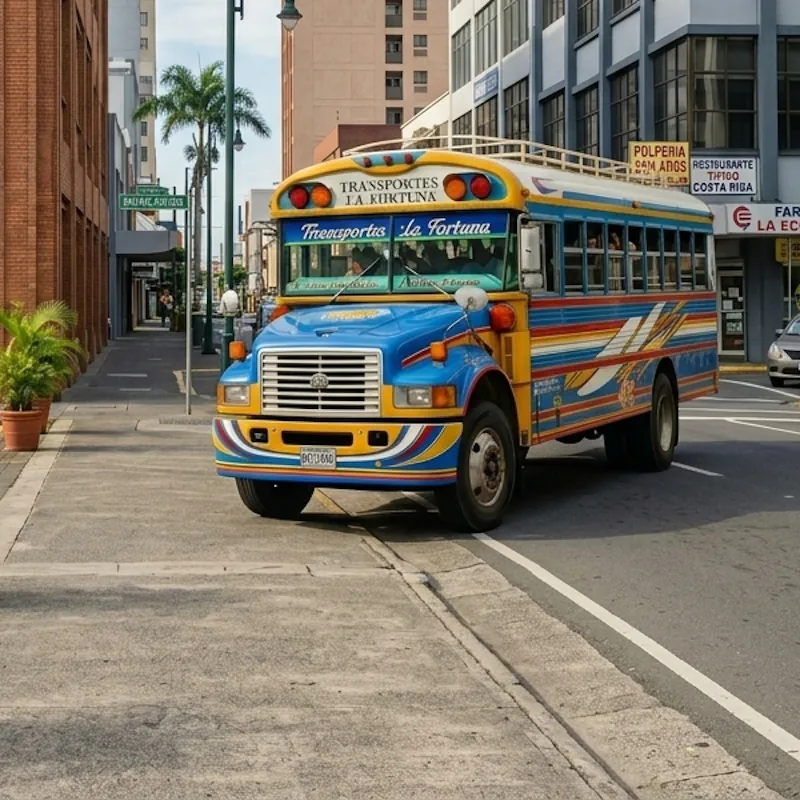
The heartbeat of Costa Rican life. Learn how to navigate the colorful, frequent, and hyper-local bus routes like a true “Tico.”

Benefits of City Busses

Efficiency meets authenticity: The best way to get around the city.

Fares typically range from 250 to 600 Colones ($0.50 – $1.20 USD), making it by far the most economical way to commute.

In urban hubs like San José, Heredia, or Alajuela, buses on major routes often pass every 5 to 10 minutes.

Experience daily life alongside locals. It’s the best place to observe the friendly, bustling “Pura Vida” atmosphere.

City buses go into deep residential neighborhoods (Barrios) where taxis might be scarce or more expensive.

San José traffic is legendary. Let a professional driver handle the narrow streets while you relax or people-watch.

Using public transit reduces the number of cars on the road, supporting Costa Rica’s national sustainability goals.

How To: Master City Bus Travel

Navigate the local city bu: Before you know it, you’ll be hopping on and off just like a “Tico”.

Find Your Route

Local buses don’t usually have a published “Master Map.” Instead, follow these cues:

  • The Moovit app is the gold standard for city buses in San José, Alajuela, and Heredia. It will show you exactly which bus “name” to look for (e.g., “Sabana-Estadio” or “Barrio Luján”).
  • City buses always have their destination and often the fare (in colones) displayed on a sign in the front window.
Locate the Bus Stop (Parada)

City bus stops can be elusive.

  • Look for a sheltered bench, a simple yellow line painted on the curb, or just a group of people standing on a corner looking expectant.
  • Wave down the bus you’re wanting to load. If the bus is full, the driver may simply point downward or shake their head and keep going.
Payment (2026 Update)

Costa Rica has made a major push for electronic payments in the last few years.

  • As of 2026, many city routes (especially in the Gran Área Metropolitana) accept contactless credit/debit cards or the SINPE-TP prepaid card. Just tap the validator near the driver.
  • For routes not yet digitized, you pay the driver directly upon boarding.
    • Fares: Usually between ₡300 and ₡700 (roughly $0.60–$1.35).
    • Exact Change: While drivers give change, it is best to have exact change.
    • Small Change: Try to use small bills (₡1,000 or ₡2,000 Colones) or coins. Do not try to pay with a ₡10,000 or ₡20,000 bills, drivers may refuse large bills and you’ll miss your ride.
Boarding and Riding

Always board through the front door.

  • Make your payment and quickly walk through the sensor turnstile or “Barra”.
  • If you have a large backpack, you may need to take it off to fit through comfortably.
  • Keep your backpack on your front or in your lap.
Exiting the Bus

City buses stop frequently, but only if requested.

  • Look for a pull-cord above the windows or a red button on the handrails. Press it about half a block before your stop.
  • Always exit through the back door to keep the flow moving.

Major Urban Hubs

Connect to the heart of the city—where every road meets a route.

Buses to San Pedro, Escazú, and Santa Ana leave from various points in the city center.

The “Station” (La Estación) is the hub for buses to the airport and Poás area.

Excellent local service connecting the university (UNA) to surrounding suburbs.

Local Tips

To ride a local city bus (the urbano) in Costa Rica like a true “Tico” in 2026, you need to navigate a mix of high-tech payment systems and old-school street smarts.

  • Destination: Ignore the bus number and look strictly at the destination placard in the front windshield to ensure you’re on the right line.
  • Flagging: Extend your arm horizontally to flag the bus down, as drivers will not stop unless they see a clear physical signal from you.
  • Electronic Payments: Starting in 2026 you can use contactless card or the SINPE-TP app for most city routes in the San José area.
  • Cash: Cash is still king, so always bring a few ₡500 coins as a backup.
  • Turnstiles: After payment, quickly step past the turnstiles at the entrance to avoid being double-charged or blocking other passengers.
  • Walking the Aisle: Grab a handrail upon boarding because city drivers often accelerate aggressively before you can find a seat.
  • Front Seats: Leave the front seats clear for seniors and pregnant women, as local law (Ley 7600) strictly enforced.
  • Prepare: Before your stop, tuck your phone and wallet into an inner zipped pocket. If you need to check a map, do it 2 minutes before you stand up to exit.
  • Look Around: Use this time to identify “Puntos de Referencia” (landmarks) like a specific Musmanni bakery or a bright church, as locals navigate by these rather than street names.
  • Observe: This is also a great opportunity to observe the people on the bus and the experience of immersing yourself with the general public in Costa Rica.
  • Secure Your Stuff: Keep your backpack on your front or in your lap. City buses can get very crowded (especially during “Presa” or rush hour), making them hotspots for pickpockets.
  • NightTime: While city buses are safe and efficient during the day, avoid waiting at city bus stops in downtown San José alone after dark.
  • Alternatives: If you’re out late, an Uber or a “Taxi Rojo” (official red taxi) is a safer bet.
  • Grab and Run: Keep your phone close to you and secure at all times in order to avoid somebody exiting the bus grabbing your phone and running with it.
  • If the pullcord or red button is broken (it happens), simply shout “¡Parada!” or “¡En la próxima, por favor!” (At the next one, please) loud enough for the driver to hear.
  • Always exit through the back door with everything tucked away in a safe place.
Scroll to Top