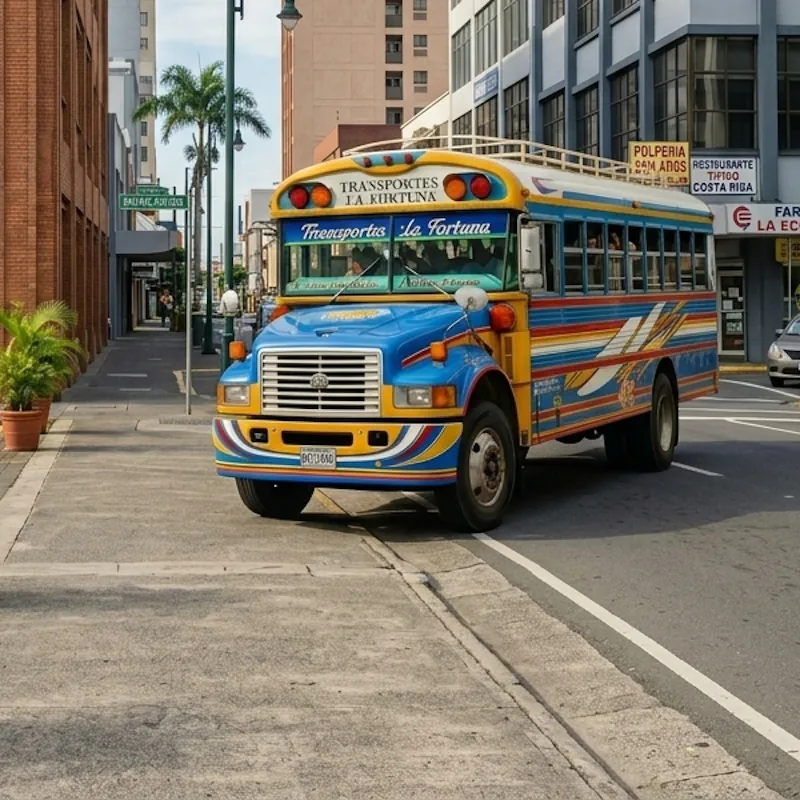
Benefits of City Busses
Efficiency meets authenticity: The best way to get around the city.
Ultra-Cheap
Fares typically range from 250 to 600 Colones ($0.50 – $1.20 USD), making it by far the most economical way to commute.
High Frequency
In urban hubs like San José, Heredia, or Alajuela, buses on major routes often pass every 5 to 10 minutes.
Cultural Immersion
Experience daily life alongside locals. It’s the best place to observe the friendly, bustling “Pura Vida” atmosphere.
Deep Access
City buses go into deep residential neighborhoods (Barrios) where taxis might be scarce or more expensive.
No Traffic Stress
San José traffic is legendary. Let a professional driver handle the narrow streets while you relax or people-watch.
Green Commuting
Using public transit reduces the number of cars on the road, supporting Costa Rica’s national sustainability goals.
How To: Master City Bus Travel
Navigate the local city bu: Before you know it, you’ll be hopping on and off just like a “Tico”.
Find Your Route
Local buses don’t usually have a published “Master Map.” Instead, follow these cues:
- The Moovit app is the gold standard for city buses in San José, Alajuela, and Heredia. It will show you exactly which bus “name” to look for (e.g., “Sabana-Estadio” or “Barrio Luján”).
- City buses always have their destination and often the fare (in colones) displayed on a sign in the front window.
Locate the Bus Stop (Parada)
City bus stops can be elusive.
- Look for a sheltered bench, a simple yellow line painted on the curb, or just a group of people standing on a corner looking expectant.
- Wave down the bus you’re wanting to load. If the bus is full, the driver may simply point downward or shake their head and keep going.
Payment (2026 Update)
Costa Rica has made a major push for electronic payments in the last few years.
- As of 2026, many city routes (especially in the Gran Área Metropolitana) accept contactless credit/debit cards or the SINPE-TP prepaid card. Just tap the validator near the driver.
- For routes not yet digitized, you pay the driver directly upon boarding.
- Fares: Usually between ₡300 and ₡700 (roughly $0.60–$1.35).
- Exact Change: While drivers give change, it is best to have exact change.
- Small Change: Try to use small bills (₡1,000 or ₡2,000 Colones) or coins. Do not try to pay with a ₡10,000 or ₡20,000 bills, drivers may refuse large bills and you’ll miss your ride.
Boarding and Riding
Always board through the front door.
- Make your payment and quickly walk through the sensor turnstile or “Barra”.
- If you have a large backpack, you may need to take it off to fit through comfortably.
- Keep your backpack on your front or in your lap.
Exiting the Bus
City buses stop frequently, but only if requested.
- Look for a pull-cord above the windows or a red button on the handrails. Press it about half a block before your stop.
- Always exit through the back door to keep the flow moving.
Major Urban Hubs
Connect to the heart of the city—where every road meets a route.
San José
Buses to San Pedro, Escazú, and Santa Ana leave from various points in the city center.
Alajuela
The “Station” (La Estación) is the hub for buses to the airport and Poás area.
Heredia
Excellent local service connecting the university (UNA) to surrounding suburbs.
Local Tips
To ride a local city bus (the urbano) in Costa Rica like a true “Tico” in 2026, you need to navigate a mix of high-tech payment systems and old-school street smarts.
Catching the Bus
- Destination: Ignore the bus number and look strictly at the destination placard in the front windshield to ensure you’re on the right line.
- Flagging: Extend your arm horizontally to flag the bus down, as drivers will not stop unless they see a clear physical signal from you.
Payment
- Electronic Payments: Starting in 2026 you can use contactless card or the SINPE-TP app for most city routes in the San José area.
- Cash: Cash is still king, so always bring a few ₡500 coins as a backup.
Getting on the Bus
- Turnstiles: After payment, quickly step past the turnstiles at the entrance to avoid being double-charged or blocking other passengers.
- Walking the Aisle: Grab a handrail upon boarding because city drivers often accelerate aggressively before you can find a seat.
- Front Seats: Leave the front seats clear for seniors and pregnant women, as local law (Ley 7600) strictly enforced.
While Riding
- Prepare: Before your stop, tuck your phone and wallet into an inner zipped pocket. If you need to check a map, do it 2 minutes before you stand up to exit.
- Look Around: Use this time to identify “Puntos de Referencia” (landmarks) like a specific Musmanni bakery or a bright church, as locals navigate by these rather than street names.
- Observe: This is also a great opportunity to observe the people on the bus and the experience of immersing yourself with the general public in Costa Rica.
Safety First
- Secure Your Stuff: Keep your backpack on your front or in your lap. City buses can get very crowded (especially during “Presa” or rush hour), making them hotspots for pickpockets.
- NightTime: While city buses are safe and efficient during the day, avoid waiting at city bus stops in downtown San José alone after dark.
- Alternatives: If you’re out late, an Uber or a “Taxi Rojo” (official red taxi) is a safer bet.
- Grab and Run: Keep your phone close to you and secure at all times in order to avoid somebody exiting the bus grabbing your phone and running with it.
Getting Off the Bus
- If the pullcord or red button is broken (it happens), simply shout “¡Parada!” or “¡En la próxima, por favor!” (At the next one, please) loud enough for the driver to hear.
- Always exit through the back door with everything tucked away in a safe place.